


The concept of monoid homomorphism is useful for expressing a formal
semantics of iteration over collections. However, it is not very
convenient as a programming construct. A natural notation for such a
construct that is both conspicuous and can be expressed in terms of
monoid homomorphisms is a monoid comprehension. This notion
generalizes the familiar notation used for writing a set in comprehension
(as opposed to writing it in extension) using a pattern and a formula
describing its elements (as oppposed to listing all its elements). For
example, the set comprehension
 describes the set of pairs
 (the pattern),
verifying the formula
(the pattern),
verifying the formula
 (the qualifier).
This notation can be extended to any (primitive or collection) monoid
 . The syntax of a monoid comprehension is an expression of the
form &oplus#oplus;{e[]Q} where
. The syntax of a monoid comprehension is an expression of the
form &oplus#oplus;{e[]Q} where  is an expression called the
head of the comprehension, and
is an expression called the
head of the comprehension, and 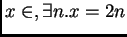 is called its qualifier and is
a sequence
is called its qualifier and is
a sequence
 ,
,  , where each
  is either
 , where
  is a variable
and is an expression; or,
is a variable
and is an expression; or,
 which is a boolean condition.
is called the accumulator.
which is a boolean condition.
is called the accumulator.
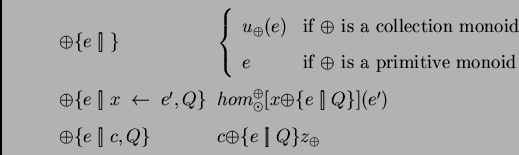
As for semantics, the meaning of a monoid comprehension is defined in terms of monoid homomorphisms.
is defined
inductively as follows:

 ,
,
 , and
, and  is a collection
monoid. is explicit, each generator
is a collection
monoid. is explicit, each generator
 in the qualifier has an implicit collection monoid
whose characteristics can be inferred with polymorphic typing rules.
in the qualifier has an implicit collection monoid
whose characteristics can be inferred with polymorphic typing rules.
Although Definition 3.28.1 can be effectively computed using nested loops (i.e., using the iteration semantics (3.13)), such would be in general rather inefficient. Rather, an optimized implementation can be achieved by various syntactic transformation expressed as rewrite rules. Thus, the principal benefit of using monoid comprehensions is to formulate efficient optimizations on a simple and uniform general syntax of expressions irrespective of specific monoids.
Thus, monoid comprehensions allow the formulation of ``declarative iteration.'' Note the fact mentioned earlier that a homomorphism coming from the translation of a comprehension encapsulates the operation in its function. Thus, this is generally taken to advantage with operations that cause a side-effect on their second argument to enable an in-place homomorphism to dispense with unneeded intermediate computation.