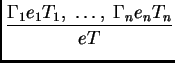
The type checker is in fact a type inference machine that synthesizes missing type information by type unification. It may be (and often is) used as a type-checking automaton when types are (partially) present.
Each expression must specify its own typeCheck(TypeChecker t) method that encodes a formal typing rule of the form:
 is a boolean condition on typing context
  ,
expression
,
expression  , and type
  .
A typing judgement &Gamma#Gamma;&vdash#vdash;e:T is read as
``under typing context , expression has type .''
A type rule or (conditional) axiom is read from the ``denominator'' to
the ``numerator.'' For example,
.
A typing judgement &Gamma#Gamma;&vdash#vdash;e:T is read as
``under typing context , expression has type .''
A type rule or (conditional) axiom is read from the ``denominator'' to
the ``numerator.'' For example,
 |
(3.4) |
is read thus: ``the expression
 has type
under typing context if the expression
has type
under typing context if the expression 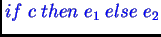 has type boolean under typing context and if the expressions
  and
and  have
same type under typing context .
have
same type under typing context .
In its simplest form, a typing context is logical
variable substitution: i.e., a mapping from type parameters to
types. Since type parameters are also types, we do have to
compose substitutions. In the formal presentation of an expression's
typing rule, the context keeps the type binding under which the typiung
derivation has progressed up to applying the rule in which it occurs.
Hence, we shall treat typing contexts as (composable) substitutions
mapping type parameter variables to types. The notation
 denotes the context defined from by: